Steppers with Encoders: When Open-loop Control Isn’t Enough

Steppers

It is good to know how to use a stepper..

Mike's avatarPhidgets

With the increasing popularity of DIY projects such as quadcopters, CNC tables and 3D printers, many people are faced with the decision of which type of motor to use in their project. For applications that require precise control of the position of the motor, the common choices are DC motors with encoders, servo motors, and stepper motors.

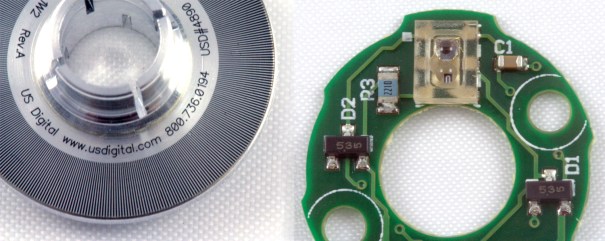
A DC motor is the standard electric motor; it will spin as fast as it can with the DC power you provide it with. On its own, a DC motor has no position control. Most DC motor controllers allow you to change the duty cycle, a value from 0 to 100% that describes how much of your power supply is being made available to the motor. However, controlling the duty cycle does not give you control over the position or even the velocity of the motor. This is where encoders come in:  an encoder…

View original post 951 more words

Posted in Robotics

Dynamic modelling of robots with rigid links (II)

Robots with closed loops

This is the second post about robot modelling. In it I explain the modelling of robots with closed loops. It is common of several manipulators, especially those ones with bigger payloads, to include a closed loop in the serial chain to allow the placement of one actuator closer to the base and making possible to distribute the mass symmetrically. Therefore, the problem of yielding to the model described in previous post, needs to take into account the closed loop and apply a loop closure function to the tree dynamics obtained by e.g. the Newton-Euler algorithm. Read more ›

Tagged with: , , , ,
Posted in Robot Dynamics, Robotics

Free access during 50 days to my paper: On the control performance of motors driven by long cables for remote handling at ITER

Thanks to the Elsevier guys I have a link to get free access to my recently published paper: on the control performance of motors driven by long cables for remote handling at ITER. It has been published in the journal: Fusion Engineering and Design.

https://authors.elsevier.com/a/1Sz3x3HHIK5fSn

Tagged with: , , , ,
Posted in Control for teleoperation, Robotics

Differential Geometry

Differential Geometry Day – http://wp.me/p2XvOY-Tn

Tagged with: ,
Posted in Mathematics

Dynamic modelling of robots with rigid links (I)

Defining the dynamic model

The conventional robotics equation describing the inner forces (1) of a kinematic chain of rigid forces in the absence of external forces can be obtained by employing any established algorithm, e.g. Newton-Euler iterative method or the Lagrangian method.

eq

(1)


Read more ›

Tagged with: , , , , ,
Posted in Robot Dynamics, Robotics, Uncategorized

Why perform sensorless teleoperation. An industrial robot approach for remote handling in radioactive facilities.

The radioactive environments can be significantly different from each other depending on the dose rate emitted and with them the requirements of the manipulators or robots used within them. In order to cope with the less demanding doses, it is likely enough to mount a hard-rad force/torque sensor in the robotic gripper, increasing with this the total cost of the robot or developing a customized shielding for a conventional sensor equipped with amplifier. When the radiation dose rate becomes very high, a hydraulic solution can be implemented with the consequent leaking risk. If that risk is wanted to be totally discarded as well as to maintain a solution with components off-the-shelf, when the dose rate increases such as in ITER-like projects, a sensorless approach can be used. This term indicates the indirect end-effector’s force and actuator’s torques estimation without using force and torque sensors. My research has proposed a sensorless force estimation of industrial robots applied to teleoperation in radioactive environments. Read more ›

Tagged with: , , , , , ,
Posted in Control for teleoperation, Force Estimation, Robotics

Radiation tolerance of robotics & telerobotics systems

In this post, a review of the main effects due to the radiation on telerobotics systems is performed in order to justify the approach I took during my research  and clarify the issues found.

Due to the radiation levels in most modern nuclear facilities or nuclear experiments are increasing, new protection measures are needed and the use of remote handling techniques becomes crucial. Different scientific facilities are mentioned here as examples, where the techniques developed in this research could be applied. These are also facilities which have been related somehow with this research. These are: CERN (Organisation Européenne pour la Recherche Nucléaire / European Organisation for Nuclear Research), ITER (International Thermonuclear Experimental Reactor) and JET (Joint European Torus). Read more ›

Tagged with: , , , , , , ,
Posted in Radiation, Robotics

Teleoperating an ABB IRB 2400-16 (II)

Delay issues found during the RS422 serial communication and RAPID program execution

Different programming and communication techniques were tested under the development of the optimum teleoperation control. Some of them have already been explained before, and some others related with the loop delay will be commented here.

esquema.png

Pseudo-code of RAPID program running on the SC4+ controller

Read more ›

Tagged with: , , , , ,
Posted in Control for teleoperation, Robotics

Teleoperating an ABB IRB 2400-16 (I)

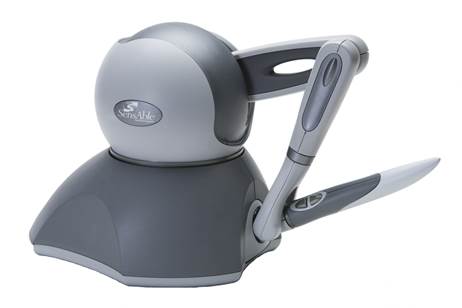
With the objective of testing my kinematics algorithms, an experimental setup was planned and commissioned. This setup was based on a bilateral control with dissimilar master and slave. The master used was the Phantom OMNI, manufactured by Sensable. It is worth noting that this device presents 6 dof of positional feedback although only 3 dof of force feedback. The first three joints are the only ones creating torque which is able to render a force in  in the master tip.

image004

Figure 1-Phantom OMNI

Read more ›

Tagged with: , , , , , , , ,
Posted in Control for teleoperation, Robotics
Follow me on Twitter