Backdrivability

There is a trend in robotics towards the use of backdrivable actuators due to multiple reasons. One of them, is the need of sharing the environment with humans. Such a robot needs flexibility to adapt the differences between real environmental condition and assumed environmental condition. The robot´s joints may need to be articulated by a human and that would require high backdrivable actuators with low friction.
There are many other applications where a backdrivable actuator is needed, for example, in teleoperation, when Position-Position control is implemented. In teleoperation, a master device is controlled by a human operator and a slave device placed in a safe area mimics the movements of the master device. Position-Position uses the difference in position between master and slave to calculate the feedback forces to the operator. The more the positional error, the greater the forces. This positional error would be much more reduced with non-backdrivable actuators, and then, more difficult to provide feedback to the operator. At the end of the day, what you want in your slave device is to behave like a human, to react to the external forces as a human would do. If having a very stiff slave, the positional error would be minimum in normal tasks and the operator would not feel anything.

In any circumstance where the estimation of the external forces is needed, a backdrivable actuator is preferred. This could also be the case of walking robots, where it is important to feel the impact between the leg and the ground and react accordingly with a determined compliance.

Backdrivability is essential for safe robotic-arm operation around people; operating in unstructured environments; for stable control of contact forces; and for exploiting Jacobian-Transpose safely to enable Cartesian control of forces, haptic objects, and direct Cartesian control of trajectories.

Backdrivability is the ability for interactive transmission of force between input axis and output axis. To get high backdrivability, we have to reduce friction of power transmission considerably. Backdrivability provide actuators with high force sensitivity and high impact resistance which adapts to quick external force mechanically.

In rehabilitation robotics, particularly in upper limbrobotics, the drives must be able to deliver high torques at low velocity. Therefore, many rehabilitation robots are driven by motor-gearbox combinations. In contrast to direct-drive motors, the backdrivability of geared drives is poor due to friction in the gearbox. The back-driving torque sb can be defined as the amount of torque the human must apply to the robotic joint in order to perform a user-driven movement. Perfect backdrivability is achieved if sb = 0.

In [1] it is suggested that a reduction ratio over 60 in harmonic drives creates non-backdrivable actuators.

The backdrivability of a gearbox is highly correlated with the friction and the efficiency. Hence, let us have a look to the efficiency of different types of gears to get a initial impression of the backdrivaility of them.

In [2] a comparison between Harmonic drives and Cycloid drives is shown. In their research, Cycloid drives fitted into the same package diameter as harmonic drives with equal torque-generating capabilities. In their research, they demonstrated many advantages over harmonic drives, including substantially greater efficiency (especially at low torques) and lower reflected inertia, and often provided a thinner profile. These benefits were offset, however, by substantial disadvantages, including significant backlash and gear ratio ripple.

They conclude that, neither Cycloid nor harmonic drives are universally superior for all applications and conditions. However, Cycloid drives should be considered for applications in anthropomorphic robots and prostheses, especially those in which size, inertia, and efficiency take precedence over backlash and torque ripple.

Gear Efficiency Comparison Table

No Type Normal Ratio Range Efficiency Range
1 Spur 1:1 to 6:1 94-98%
2 Straight Bevel 3:2 to 5:1 93-97%
3 Spiral Bevel 3:2 to 4:1 95-99%
4 Worm 5:1 to 75:1 50-90%
5 Hypoid 10:1 to 200:1 80-95%
6 Helical 3:2 to 10:1 94-98%
7 Cycloid 10:1 to 100:1 75% to 85%

Double helical gear drives are considered to be more efficient than single helical gears.
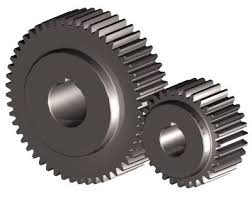
spur gear

Spur Gears

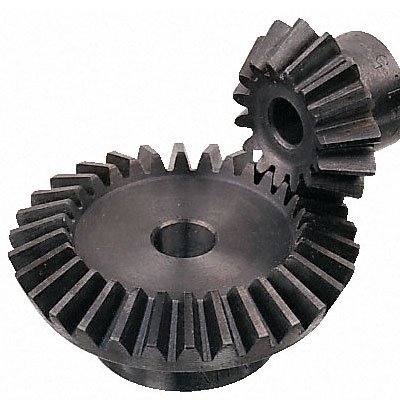
Straight Bevel

Straight Bevel Gears

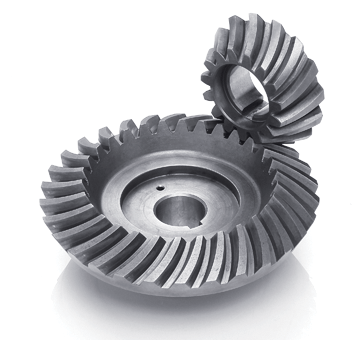
7_spiral-bevel-gears

Spiral Bevel Gears

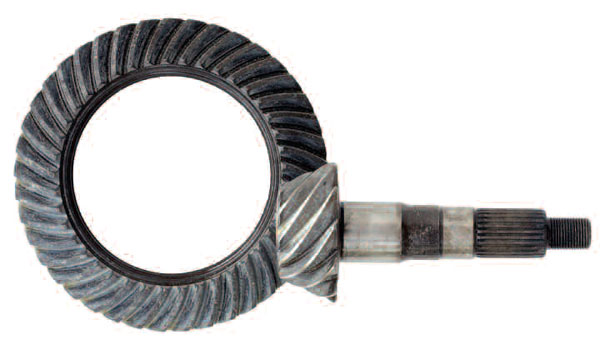
hypoid-gear2

Hypoid Gears.

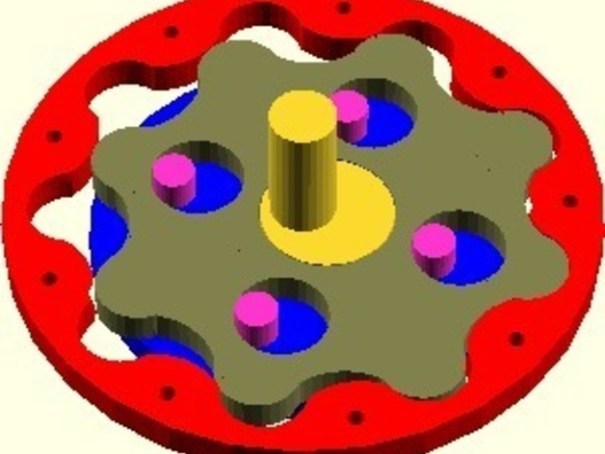
cycloid

Cycloid Gear.

Double_Helical_Gears_edit (1)

Double Helical Gears.

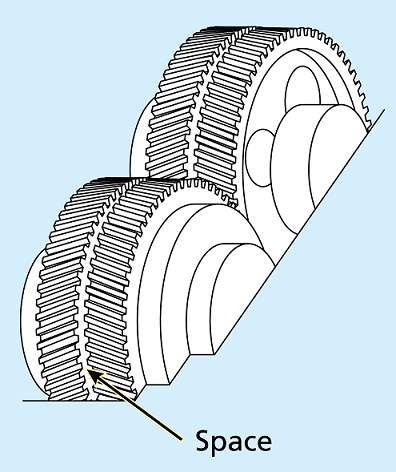
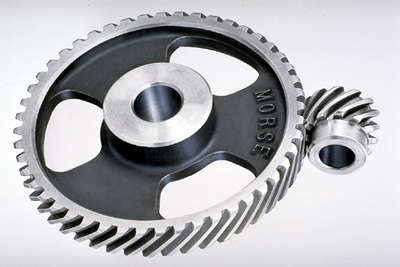
gear-helical2

Helical Gears

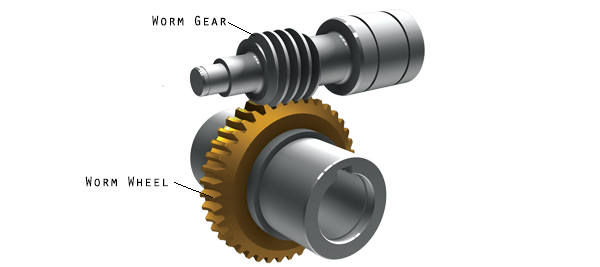
worm

Worm Gears.

Backdrivability of ball screws

Check out my article on backdrivability of ball screws to discover the main parameters that make them backdrivable.

[1] Instrumented Harmonic Drives for Robotic Compliant Maneouvres. H. Kazerooni.
[2] Cycloid vs. Harmonic Drives for use in High Ratio, Single Stage
Robotic Transmissions. Jonathon W. Sensinger, Member, IEEE and James H. Lipsey.2012 IEEE International Conference on Robotics and Automation
RiverCentre, Saint Paul, Minnesota, USA

Tagged with: , , , , , , ,
Posted in Robotics

Notes on encoder resolution for velocity control of motors

The simplest velocity estimation method is the Euler approximation that takes the difference of two sampling positions divided by the sampling period. Typically the position measurements are taken with encoders or resolvers which contain stochastic errors which result in enormous noise during the velocity estimation by the Euler approximation when the sampling period is small and the velocity low [1] .

Image result

Encoder

Different alternatives have been tried which utilise more backwards steps to reduce the noise but introducing a small delay. On [3]  a first order adaptive method is shown which is able to vary the backward steps depending on the speed. Also, on [2] it has been found that 3 steps is the best for a sampling rate of 2500 Hz in their experiments with an encoder of 655360 pulses per revolution. They also implemented a Kalman observer and non-linear observers, obtaining the same results than an averaging of the Euler formula. On [4] a Kalman filter is tested assuming a normal distribution of the position error. On [1] a dynamic method which varies the samples used for averaging depending on the speed is developed with very good results. For example, given a desired relative accuracy r_j of the velocity calculation, with encoder measurements by the formula below taken from [1] , it is possible to derive the required amount of time for obtaining a velocity measurement. This is assuming that the velocity is not calculated with two consecutive samples, but with two samples separated a certain number of backwards steps s_j in order to increase the velocity resolution. For an incremental encoder with a resolution R, if the position q(t) is sampled with a sampling period T, and for k = 1, 2, …, the discrete sampled position at
time
kT is given by θ(k). The relative accuracy is given by:

Capture

Where v_j is the real velocity and \hat{v_j} is the estimated with the measurements. For example, in order to obtain a relative accuracy of r_j= 2%, s_j = 100, i.e. 100 past pulses have to be traced back on the velocity calculation. If we want to achieve this with an encoder of 10.000 lines/rev, the elapsed angular space for 100 pulses would result to be: 3.6 °. With a motor running at 1 rpm, the required amount of time for completing that angular slot is 10 ms. This amount of delay is detrimental for a good bilateral performance.


[1] G. Liu. “On velocity estimation using position measurements”. In: Proceedings
of the american control conference,
Anchorage, AK May 8-10. 2002, vol. 2, pp. 1115-
1120.

[2] A. Jaritz, M.W. Spong. “An experimental comparison of robust control algorithms on a direct drive manipulator”. In: IEEE Transactions on Control Systems
Technology. 1996, vol.4, no.6, pp.627-640. doi: 10.1109/87.541692

[3]  F. Janabi-Sharifi, V. Hayward, C-S.J. Chen. “Discrete-time adaptive windowing for velocity estimation”. In: IEEE Transactions on Control Systems Technology.2000, vol.8, no.6, pp.1003-1009. doi: 10.1109/87.880606

[4] P.R. Belanger, P.Dobrovolny, A. Helmy, and X. Zhang. “Estimation of angular
velocity and acceleration from shaft-encoder measurements.”
The International Journal
of Robotics Research.
1998, vol. 17, no. 11, pp. 1225-1233

Tagged with: , , , , , , , ,
Posted in Actuators, Robotic devices, Robotics

Motor Selection for Robots (I)

In this post I am going to review the main parameters affecting the selection of the correct motor and gears for your application.

Motors are a very common component in many devices and embedded systems.  To function properly, their selection requires a careful step by step process that relies heavily on the intended operation of the motor. Therefore, before motor selection can begin, it is beneficial to define what the motor will have to do, the performance goals of the motor and overall system (i.e. how will you measure that it’s doing well), and how the motor will interact with the other system components (such as the power system).  Understanding these parameters will help the selection process by keeping the focus on what your system must achieve, and in turn can help you to better define motor technical requirements.

This post and the following will use a wheeled robot in order to illustrate the process to be followed on the determination of a motor.

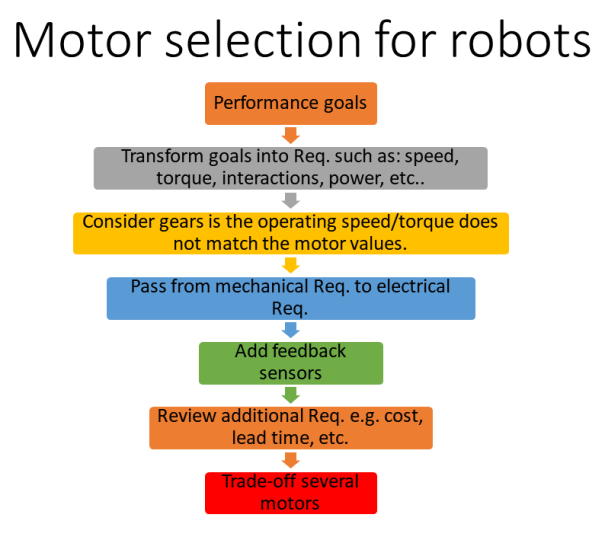
Motor selection for robots

The most important steps when selecting a motor for a certain application are:

  1. Determine key performance goals of the system
  2. Transform the goals into torque and rotational speed requirements for the motor
    1. Speed
    2. Torque
    3. Motor connection interactions (i.e. what is the motor connected to and how does that influence its performance)
    4. Speed-Torque Curve
    5. Mechanical Power
    6. Constant Voltage Torque-Speed Line
  3. Utilize gearing systems if the operating point speed and torque do not match the motor speed and torque
  4. Relate these mechanical requirements into electrical power system requirements, including the potential of motor overheating
  5. Add sensors, such as encoders, based on the information needs of other systems
  6. Review additional requirements such as cost, time, environmental, serviceability and mounting requirements
  7. Deal with the reality that there is rarely a motor that exactly matches the calculated requirements and make proper trade-offs
    1. Review all requirements
    2. Determine rating system
    3. Generate a selection of motors
    4. Compare all options and select a motor

In the next sections, these steps will be review and explained with examples of application.

Read more ›

Tagged with: , , , , , , , , , ,
Posted in Actuators, Robotics

Main telerobotic platforms

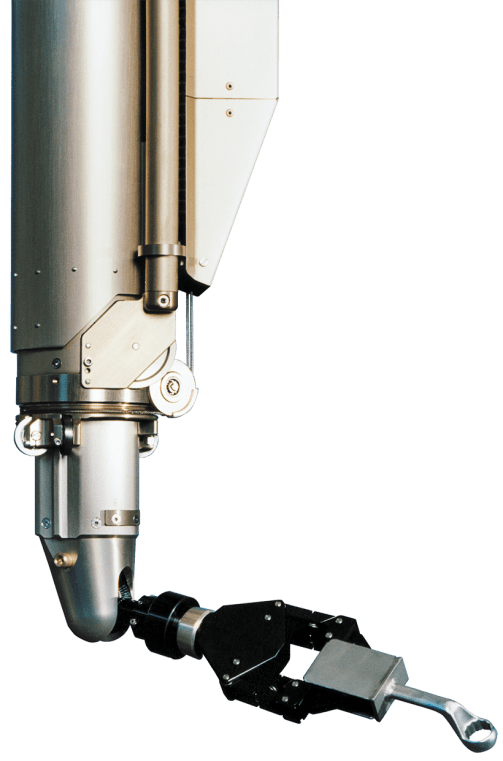
In the following tables I list some of the main remote handling devices used in the industry and research. Table 1 shows some of the most important remote handling master arms such as Dexter manufactured by Oxford Technologies Ltd. and Telerob. The reader should keep in mind that this data is from 2015 and these technologies could get outdated quickly.


Master-Slave Manipulator A100 Telerob (Wälischmiller)

Master-Slave Manipulator A100 Telerob (Wälischmiller)

Master-Slave Manipulator A100 Telerob (Wälischmiller)

Master-Slave Manipulator A100 Telerob (Wälischmiller)

dexter

Dexter Manipulator manufactured by Oxford Technologies Ltd.

Reference Supplier Product/Solution
1 Telerob (Wälischmiller) EMSM-2B Master Arm
2 CARRS (Wälischmiller) TELBOT Master Arm
3 Haption Virtuose 6D40-40
4 Cybernétix Master arm
5 Cybernétix MA23M master
6 Oxford Technologies Dexter

Table 1. Remote handling master arms.

Reference Supplier Product/Solution
7 Haption Virtuose 6D35-45
8 FCS Moog HapticMaster
9 Sensable PHANTOM Premium 3.0/6DoF
10 Force Dimension sigma.7
11 Force Dimension delta.6
12 Novint Falcon
13 MPB Technologies Freedom 7S
14 Quanser 5 DoF Haptic Wand
15 Mimic Technologies Mantris
16 Butterfly Haptics Maglev 200

Table 2. Haptic interfaces

Reference Supplier Product/Solution
17 Barrett WAM 7DoF
18 KUKA Lightweight robot 4+
19 Haption Inca6D

Table 3. Research devices.

Reference Supplier Product/Solution
20 Schilling Master Controller
21 Perry Slingsby Systems Master Controller
22 International Submarine Engineering Master Controller
23 Kraft Master Controller

Table 4. Subsea manipulator controllers.

Reference Supplier Product/Solution
24 Spaceapplications SAM: Sensoric Arm Master Exoskeleton
25 Haption Able

Table 5. Exoskeletons.

Tagged with: , , , , ,
Posted in Robotic devices, Robotics

Upgrading of the Prusa i3 X carriage and extruder support

Prusa i3 X carriage and Extruder support from Semitronics (Side View)

I decided to update the X-carriage and extruder that I bought from Semitronics Industries due to several reasons.

-Firstly, the X-carriage (Red part in the picture) that holds the bearings, was too weak at the point where the nuts are held in position. That caused my part to break and I could not tight the bolts anymore.

Figure 0. New model of the X-Carriage and extruder for the Prusa i3.

Read more ›

Tagged with: , , , , , , , , ,
Posted in 3D printing, Robotics

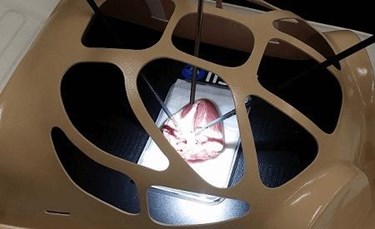
New Robotic Surgery Platform First To Offer Tactile Response

http://www.meddeviceonline.com/doc/new-robotic-surgery-platform-first-to-offer-tactile-response-0001

Tagged with:
Posted in Force Estimation, Robotics

Established solutions to the overvoltage produced by the reflections 

In order to protect drives, cables and motors from the overvoltage caused by reflections the obvious solution is to reduce the bus voltage [1] with respect to the cable insulation rating. Even with 100% overshoot in voltage, an IGBT drive with 300Vdc bus can use a standard 1000Vpk cable since the overshoot of 600V will be far from the cable insulation limits [2]. When this is not possible, most solutions are based on inserting especial electronic devices to reduce the standing wave via impedance matching, filtering or active modification of the PWM pulses [3,4].

Simpler solutions consist of an output reactor at the inverter end. In Ref. [1] it is proved how the insertion of a reactor at the drive end modifies the reflected waveform by changing it into a less destructive wave, with slower rise-time and possibly a reduced amplitude. The effects of adding a reactor at the motor end are similar to those of adding a reactor at the drive end. A very interesting solution mentioned in Ref. [1,7] is the potential installation of dv/dt filters which basically transform the PWM driver output into a smooth sinewave. These filters combine appropriate R-L-C components to form a damped low pass filter. The maximum cable length with which a sinewave would create reflections is several orders of magnitude greater than a PWM signal.

A low-loss LC filter clamped by diode bridges has been proposed in Ref.[7]. For this filter,the LC resonating voltage is clamped to the dc-bus voltage by virtue of the fast recovery diodes, and the rising time of the inverter output voltage can be controlled by modifying the values of L and C of the filter. Compared with the traditional LC filters the physical dimensions of diode clamping filters are smaller. Moreover, the power losses in the clamping circuit are decreased in comparison to the losses in the damping resistors of RLC filters [7]. However, the use of these devices require special features in the power drive to allow access to the DC bus which are rarely available.

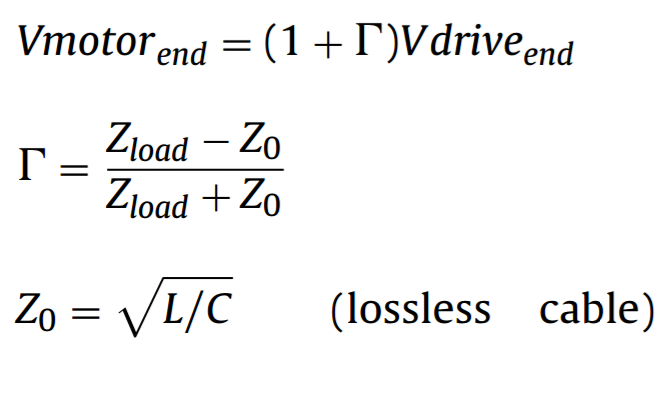
A cost effective method for controlling the voltage reflection is a termination network or a terminator device that removes impedance discontinuities to maintain the reflected waveform below potentially destructive levels. These devices are installed in parallel with the motor where they load the receiving end of the cable with a Zload ohmic resistor value equal to the cable Z0, which makes Γ= 0 in Eq. (2) and eliminates the reflected wave.

Tagged with: , ,
Posted in Control for teleoperation, Robotics

Standing waves in PWM motor drives and their effect on the actuator control.

The inverter of the PWM drives does not produce sinusoidal output voltage waveforms; instead, it generates a continuous train of pulses which are transmitted to the motor terminals via the motor cable. Peak pulse voltage atthe drive outputis equalto the drive DC bus magnitude (Vbus) and it is characterised by the step rise and fall times (trise, tfall) controlled by the GTO, BJT or IGBT semiconductor switching device used. 

The peak pulse seen at the motor end is not necessarily the Vbus sent by the drive and it depends on a combination of factors which define the whole system behaviour. These factors are: the trise and tfall characteristics of the PWM, the cable transmission line characteristics, the cable length and the motor impedance. A commonly used model suggests that peak voltages up to twice of the Vbus can appear at the motor end of the cable, although in other references, more than double of that voltage is observed in real experiments. 

The process leading to this can be summarised as follows:

At the beginning of each PWM pulse, the drive has to charge the characteristic inductance and capacitance of the cable. 

When the edge reaches the motor end of the cable a reflection occurs because of the step change in impedance (the one of the motor is almost invariably much higher thanthe one ofthe cable). This effect is more pronounced with small motors due to their higher impedance. 

The reflection then returns to the drive, where it is reflected again but in negative sense, and when it returns to the motor, it cancels the overvoltage.

The overshoot lasts about twice the time of flight in the cable. If the rise time of the pulse is longer than twice the time of flight in the cable, the overshoot is cancelled before it reaches 100%.

A measure of the overshoot size that can be caused on the motor end of a cable is defined has a “Reflection Coefficient”, and it is a function of the cable surge impedance (Z0) and the load surge impedance (Zload) presented at the receiving end of the cable. 

where L is the cable inductance per unit length of cable and C is the cable capacitance per unit length of cable. Whenever the cable surge impedance does not match the surge impedance ofthe motor, a reflected wave will occur at the motor terminals.

There is a common agreement in the literature about the adverse effects in motor control when using long cables due to the over-shoot voltages. A research has used a different set of simulated with a PMSM (Permanent Magnet Synchronous Motors) motor in Matlab©. They implement a PI regulator and study the influences on the control performance during velocity control. The results show that the speed controller rejects load disturbance faster at shorter cable lengths. On a different test, by loading the motor at a certain instant with a constant torque, they show that steady state error is increased when the speed is lowered.

Tagged with: , , , ,
Posted in Control for teleoperation, Robotics

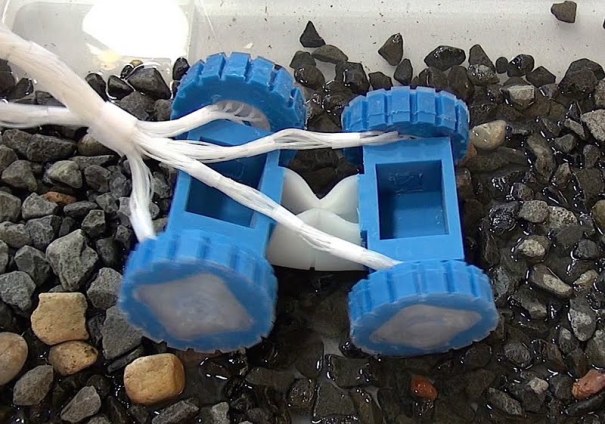
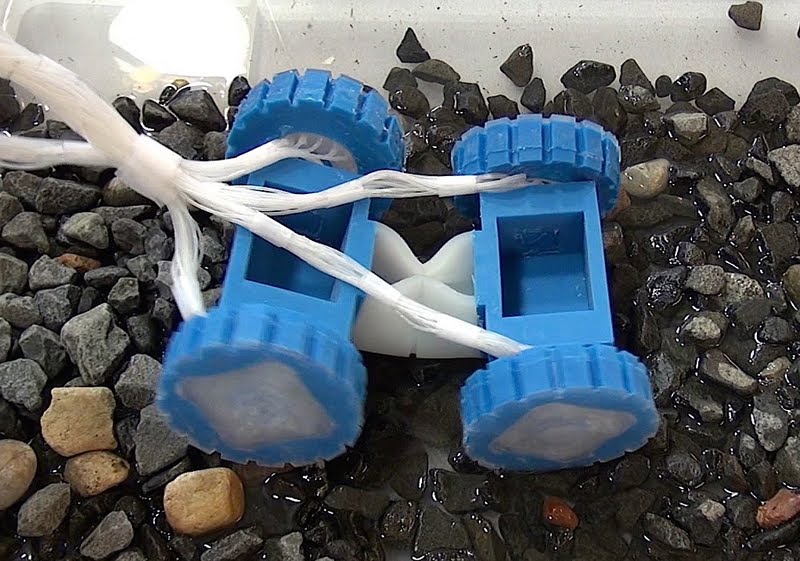
Wheeled Robot With Soft Rotary Motors Is 100% Squishy

http://spectrum.ieee.org/automaton/robotics/robotics-hardware/wheeled-robot-with-soft-rotary-motors?utm_source=feedburner&utm_medium=feed&utm_campaign=Feed%3A+IeeeSpectrum+%28IEEE+Spectrum%29

Tagged with: , ,
Posted in Robotics

The rise of soft robots and the actuators that drive them

http://m.machinedesign.com/robotics/rise-soft-robots-and-actuators-drive-them

Tagged with: ,
Posted in Robotics
Follow me on Twitter